About
One of the most important nature excursions in Evros leads to the Dadia-Lefkimi-Soufli Forest National Park, a large protected area in the heart of Evros, known throughout Europe for its unique importance for birds of prey.
The National Park covers approximately 428,000 stremmata and lies in a distinctive geographic position, at the crossroads of Europe and Asia and near a major bird migration corridor. The landscape is a mosaic of forests, clearings, scrubland and agricultural land, shaped by the long coexistence of people and nature.
The area is protected for its exceptionally rich biodiversity, and in particular for the birds of prey that nest or pass through here.
The Dadia Forest
The forest is characterised by extensive wooded areas, with oak and pine, glades and ravines that create a very different landscape from the lowland and coastal parts of Evros.
The area is a habitat for many species of wildlife. Among the animals one may encounter in the wider area are roe deer, wild boar, foxes, hares and wolves, while the presence of many bird species makes the forest particularly interesting for nature watchers.
Dadia's great value, however, lies mainly in its birds of prey.
The Cinereous Vulture and the Raptors
Dadia is one of the most important sites in Europe for the Cinereous Vulture (Aegypius monachus), one of Europe's largest birds of prey.
Despite the heavy losses caused by the 2023 wildfire, the species' population continues to show remarkable resilience. According to the most recent data from OFYPEKA, 44 active Cinereous Vulture pairs were recorded during the June 2026 breeding season, a number that remains close to the high of 47 pairs recorded the previous year.
The area is also home to black storks, short-toed eagles, common buzzards, lesser spotted eagles and other raptor and forest species. Sightings are not guaranteed, as these are wild animals, but their very presence is one of the main reasons Dadia has gained international renown.
Dadia Information Centre
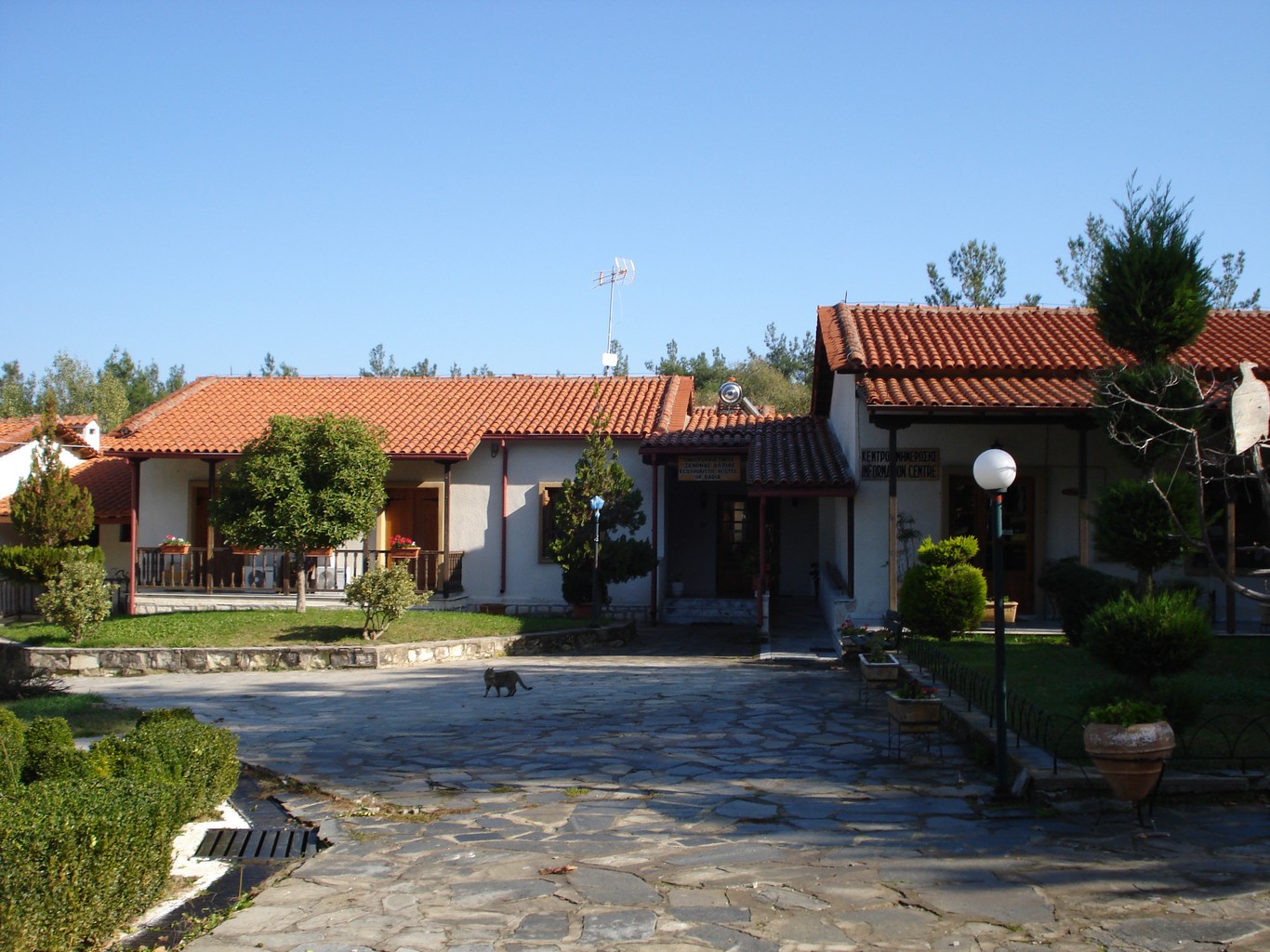
Before setting out to explore the area, it is worth stopping at the Information Centre of the Dadia-Lefkimi-Soufli National Park, in the village of Dadia.
There you can learn about the ecosystem, the area's species, the routes currently available and the current access conditions.
The Centre is open daily 08:00-16:00, and for information on visits and routes you can call 25540 32202. OFYPEKA also provides the number 25540 32209 for information and bookings for the Birds of Prey Observatory.
Hiking in the Forest
Dadia has historically had a network of marked hiking trails running through forest, clearings, old cart tracks and ravines.
Here, though, particular caution is needed: after the major 2023 wildfire, the condition of the trails has changed, and it should not be assumed that all the old trails are available today.
The older yellow and orange trails have been affected by the burned areas and have at times been closed. The situation may keep changing as restoration and clearing work continues.
So for an actual hike in Dadia, do not rely on old maps or descriptions without checking first. Before setting out, contact the Information Centre to find out which route is open and safe on the day.
The Gkimprena Trail
One of the area's best-known hiking routes is the Gkimprena trail, marked in red and blue.
The classic route is about 10 km, of moderate difficulty, and leads towards the summit of Gkimprena. It is a route for hikers in good physical condition, not a casual walk.
There are also more recent trail records for the area, but trail conditions may have changed due to the effects of the wildfire and the forest's natural regeneration. For that reason, up-to-date information from OFYPEKA should always precede any hike.
The Route to the Observatory
For those who want to experience Dadia without a long hike, there is organised access to the Birds of Prey Observatory.
OFYPEKA runs a 15-seat bus transferring visitors to the observatory. The departures currently listed by the Information Centre are 08:30, 10:00, 11:30 and 13:00, running daily, Monday to Sunday. A seat requires booking/confirmation by calling 25540 32209.
This matters, because visitors do not need to treat a visit to Dadia purely as a hike. You can experience the forest and reach the observatory via the organised transfer, and then spend time in the village and the wider area.
Dadia After the Wildfire
Today's Dadia looks different from how it did before the major 2023 wildfire.
The fire caused extensive loss of forest vegetation and habitat, yet the area remains an exceptionally important ecosystem and is undergoing natural regeneration alongside active conservation work.
The resilience of the ecosystem is also reflected in the Cinereous Vulture's trajectory. OFYPEKA continues to monitor the population and carry out conservation actions, including artificial nests.
This makes visiting Dadia today a different experience: you see not just an old, dense forest, but a living ecosystem that is recovering and continues to host rare species.
Dadia as a Day Trip
If you have a full day available, it is worth not limiting your visit to the Information Centre.
You can start at Dadia, learn about the area and the routes available, visit the observatory via the organised transfer, and then explore the village and the wider area.
For those who want an actual hike, Gkimprena is the best-known option, provided the trail is open and access has been confirmed by the responsible authority.
The trip can also be combined with a visit to Soufli, known for its centuries-old tradition of silk and sericulture, creating a complete day route through northern Evros.
What to Do in Dadia
- Visit the National Park Information Centre.
- Watch birds of prey at the Observatory.
- Hike, only on an open and confirmed trail.
- Climb towards Gkimprena, for more experienced hikers and only when the route is available.
- Nature photography and wildlife watching.
- Explore Dadia and the surrounding villages.
- Combine the trip with Soufli.
Useful Information
- Dadia Information Centre: daily 08:00-16:00.
- Phone: 25540 32202.
- Observatory / bookings: 25540 32209.
Before any hike, especially in the summer months, be sure to contact the Information Centre about trail conditions and any restrictions due to fire risk. Access to protected forest areas may be limited depending on conditions and fire danger.
Bring plenty of water, a hat, sunscreen and suitable shoes, and while hiking stay on the permitted routes.
A Different Experience in Evros
Dadia is not just another forest for a walk. It is a place where wildlife, birds of prey, forests and human history in Evros coexist in one of the country's most important protected areas.
From the easy visit to the Information Centre and the Observatory to a more demanding hike to Gkimprena, the area can offer different experiences depending on the visitor's time and physical condition.
And today, after the major changes brought by the 2023 wildfire, Dadia has one more reason to visit: to see up close a unique ecosystem that continues to regenerate and to host some of Europe's most impressive birds of prey.
Useful Tips
- Κέντρο Ενημέρωσης Δαδιάς: καθημερινά 08:00-16:00, τηλ. 25540 32202.
- Παρατηρητήριο Αρπακτικών Πουλιών: δρομολόγια 08:30, 10:00, 11:30, 13:00 - κράτηση/πληροφορίες στο 25540 32209 (ΟΦΥΠΕΚΑ).
- Πριν από κάθε πεζοπορία επικοινωνήστε με το Κέντρο Ενημέρωσης για την τρέχουσα κατάσταση των μονοπατιών μετά την πυρκαγιά του 2023.
- Το μονοπάτι της Γκίμπρενας (~10 χλμ., κόκκινη-μπλε σήμανση) απαιτεί καλή φυσική κατάσταση.
- Πάρτε μαζί αρκετό νερό, καπέλο, αντηλιακό και κατάλληλα παπούτσια. Μην απομακρύνεστε από τις επιτρεπόμενες διαδρομές.




%20scale(8.3333)%22%20fill%3D%22none%22%20stroke%3D%22%23f6c453%22%20stroke-width%3D%221.4%22%20stroke-linecap%3D%22round%22%20stroke-linejoin%3D%22round%22%3E%3Cpath%20d%3D%22M12%202.5%2014.7%209l6.8.6-5.1%204.5%201.6%206.6L12%2017.3l-5.9%203.4%201.6-6.6-5.1-4.5L9.4%209%2012%202.5Z%22%20%2F%3E%3C%2Fg%3E%3C%2Fsvg%3E)