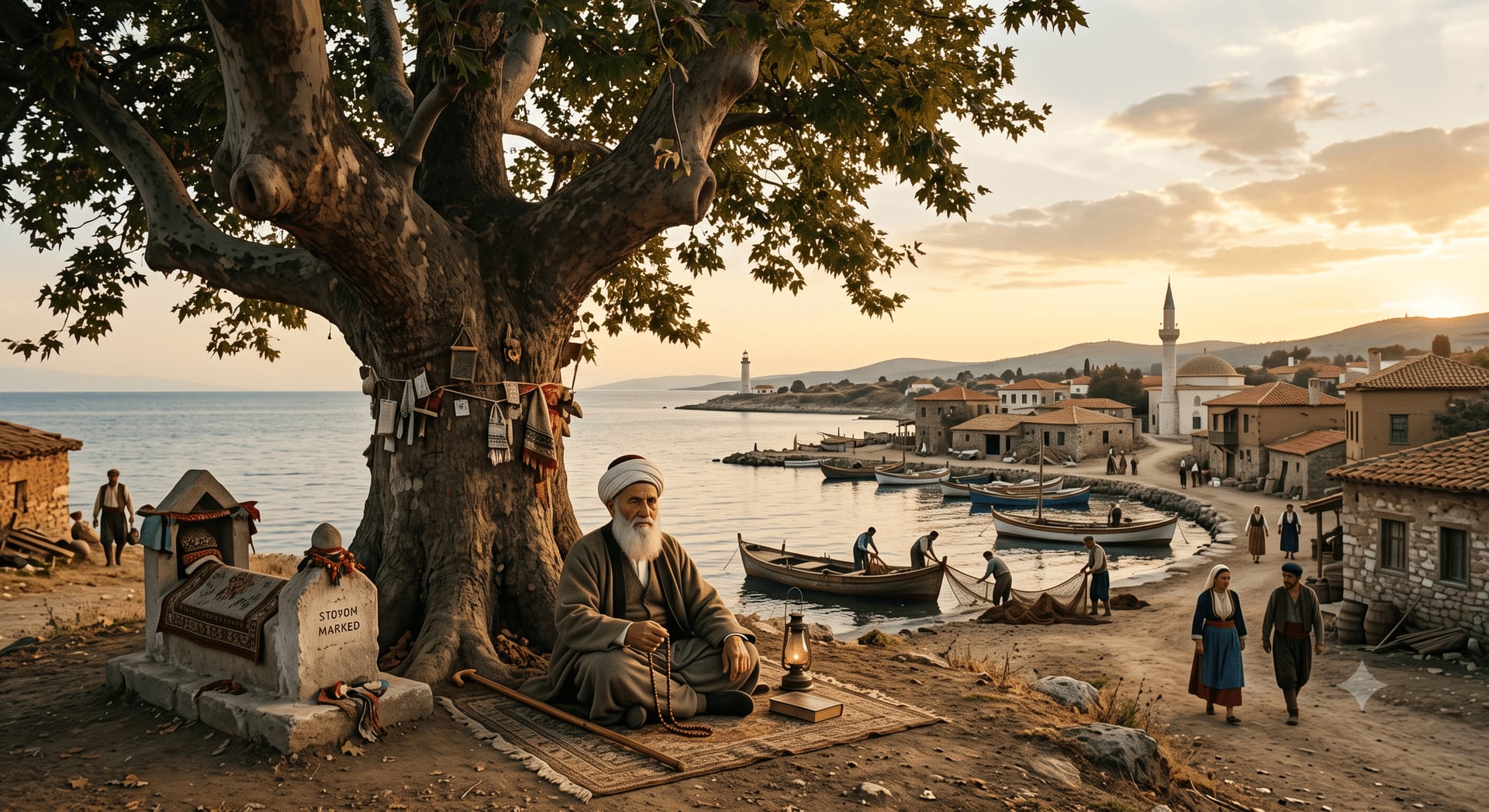
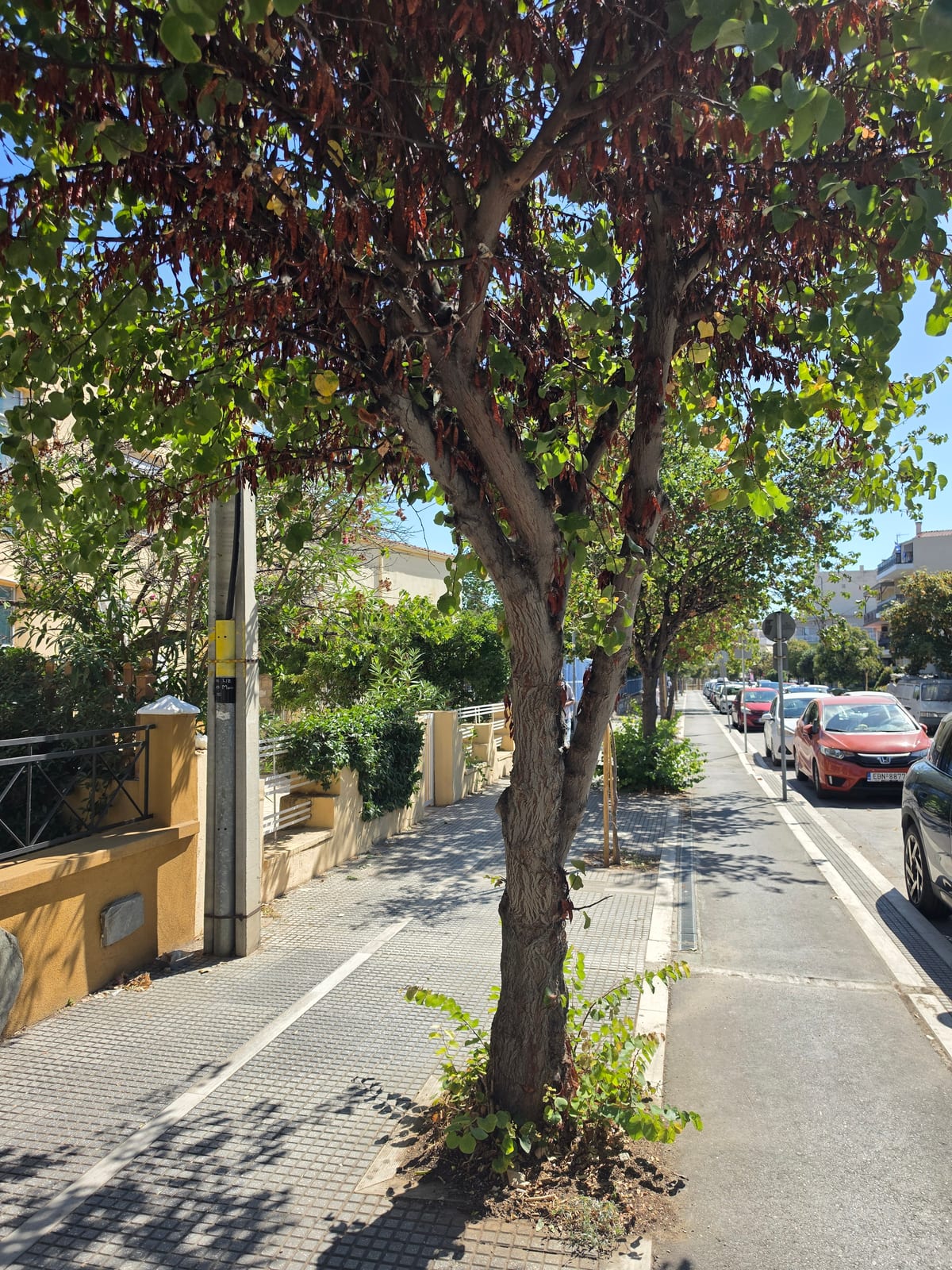
Modern Alexandroupoli was founded in the mid-19th century as a small coastal settlement by fishermen who came mainly from Ainos and the surrounding villages. During the Ottoman period, it became known as Dedeagatch, a name associated with an old local tradition. The name “Dedeagatch” comes from the Turkish words dede (“elder” or “grandfather”) and ağaç (“tree”), and is commonly translated as “grandfather tree”. According to local tradition, an elderly dervish lived for many years beneath a large tree and was buried beside it. The tree became a landmark for the area and gave its name to the settlement. Following the city's liberation on 14 May 1920, it was decided to replace the Ottoman name with “Neapoli”, meaning “new city”. On 8 July 1920, the young King Alexander I of Greece visited the city and arrived at its port. His visit was an important event for the newly liberated city. The mayor at the time, Emmanouil Altinalmazis, announced to the king the Municipal Council's decision to name the city after him, in honour of his visit. The name “Alexandroupoli”, meaning “city of Alexander”, was gradually established in honour of King Alexander I. The new name was formally established through the administrative process in the autumn of 1921, definitively replacing “Dedeagatch”.
Ιστορία
14 May: The Liberation of the city
A brief historical overview from the Balkan Wars to its final incorporation into Greece. On 8 November 1912, during the First Balkan War, Dedeagatch was captured by Bulgarian forces. On 11 July 1913, during the Second Balkan War, it was temporarily liberated by Greek forces (with significant support from the Greek navy and the battleship Averof under Admiral Pavlos Kountouriotis). Under the Treaty of Bucharest (10 August 1913), the city and the rest of Western Thrace were awarded to Bulgaria. After World War I and the Treaty of Neuilly (1919), Western Thrace came under temporary Inter-Allied (mainly French) administration. Final liberation took place on 14 May 1920. Greek troops (primarily the Xanthi Division under Konstantinos Mazarakis-Ainian, which landed by sea, in coordination with the 9th Serres Division under Epameinondas Zymvrakakis) entered the city. The French flag was lowered and the Greek flag was raised. It was initially renamed Neapolis and shortly afterwards Alexandroupoli, in honour of King Alexander I who visited the city. 14 May is celebrated every year in Alexandroupoli as a local public holiday known as “Eleftheria” (Liberation Day).
Ιστορία
The city grid and the Russian officers
For decades, popular tradition has held that the wide street grid of central Alexandroupoli - parallel streets with no dead ends, in stark contrast to the narrow lanes typical of Ottoman towns of the era - was designed by Russian officers stationed in what was then Dedeagach during the Russo-Turkish War of 1877-78. Recent research based on contemporary Constantinople newspapers challenges this account: the Russian military presence in the area lasted barely a year, and Dedeagach was at the time a small settlement with no pressing need for town planning. The grid appears to have actually taken shape around 1885, through cooperation between the Ottoman administration and the Oriental Railways company - seven years after the Russians had left. Despite the disputed origin story, the imprint of this layout remains clearly visible in the city centre today.
FEATURED
Ιστορία
The History of Alexandroupoli
In the southeastern corner of Western Thrace, human settlement is attested as early as the Neolithic period (4500-3000 BCE). Little evidence survives from the Bronze Age, but in the Early Iron Age (1050-650 BCE) Thracian tribes settled the area - among them the Cicones, the people Odysseus and his companions clashed with on their way back from Troy, raiding their city, Ismaros. Roman itineraries from the 4th century and the writings of Herodotus identify the site with the ancient city of Sale, about 11 km west of Traianoupolis. In the Byzantine period the area played an important role as a border with Constantinople and was guarded by strong military installations; in the centuries that followed, up to the 19th, it appears to have been largely abandoned and overgrown with forest. The modern city began as a small fishing settlement founded in the 19th century by fishermen from Ainos, Makri and Maroneia, who named it Dede-Agach. Several stories explain the name - two of the most common trace it either to a Turkish holy man (dede) buried under an ancient oak (agach), or simply to the many oak trees along the shore. The turning point came in 1871, when the Ottoman Empire decided to route the railway through the town; within a few years Greek, Armenian, Turkish, Levantine, Jewish and Bulgarian merchants and craftsmen arrived, building a new multicultural trading city and a hub for all of Thrace's goods. By 1912 eight foreign consulates operated there. In 1878, under the Treaty of San Stefano, Dede-Agach came under Russian military administration for about a year, during the Russo-Turkish War of 1877-78, while remaining part of the Ottoman Empire (as the seat of the Sanjak of Dedeagac, within the Adrianople Vilayet) until the Balkan Wars. For decades it was popularly believed that Russian engineers of that era had drawn up the city's wide street grid running perpendicular to the seafront; recent research based on contemporary Constantinople newspapers, however, suggests this is more likely a myth, since Dede-Agach was then a small settlement with no pressing need for town planning and the Russian military presence was brief. The plan appears to have actually taken shape around 1885, through cooperation between the Ottoman administration and the Oriental Railways company, and remains essentially unchanged today. The city's development continued with public works, churches, schools and a hospital; in 1897 it welcomed the Orient Express, and in 1905 Ion Dragoumis was appointed vice-consul there. In 1912, during the Balkan Wars, Bulgarian troops occupied the city, formalised by the 1913 Treaty of Bucharest; many Greeks left rather than watch monuments and archives destroyed. After the First World War and the Treaty of Neuilly (1919), the area was temporarily governed by an Inter-Allied Administration under Harisios Vamvakas, an associate of Eleftherios Venizelos, until 14 May 1920: the 9th Serres Division, under Epaminondas Zymvrakakis, liberated the city - the French flag was lowered, the Greek flag raised, and the city handed over by police director K. Daniil. It was first named Neapoli, a name that did not last: local authorities renamed it Alexandroupoli in honour of King Alexander, who passed through the area on his way to liberate Adrianople. Shortly after, the city gave shelter to refugees from Smyrna. The Treaty of Lausanne (1923) finally ratified the Treaty of Neuilly, ceding Western Thrace to Greece (in exchange for Eastern Thrace going to Turkey). A period of renaissance followed, led by intellectual figures such as Theodoros Kastanos, Athanasios Spanos and Achilleas Samothrakis, interrupted again by the Second World War and a new Bulgarian occupation. Liberation came under the first Deputy Governor-General, Alexandros Papathanasis, and the city found its rhythm again, developing steadily ever since. Alexandroupoli is now the administrative centre of Evros, with 59,723 residents in the city and 71,751 across the municipality (2021 census), home to the Medical School of the Democritus University of Thrace, with an active port, an airport, and a multicultural heritage still visible in its architecture and stories. In recent years its port has emerged as a strategic energy and logistics hub: since October 2024 a floating LNG terminal (FSRU) has been operating commercially just offshore, the first of its kind in Greece, strengthening the energy security of Southeastern Europe; the port remains in state ownership and has also gained added importance as a transit point for allied military forces.
Ιστορία
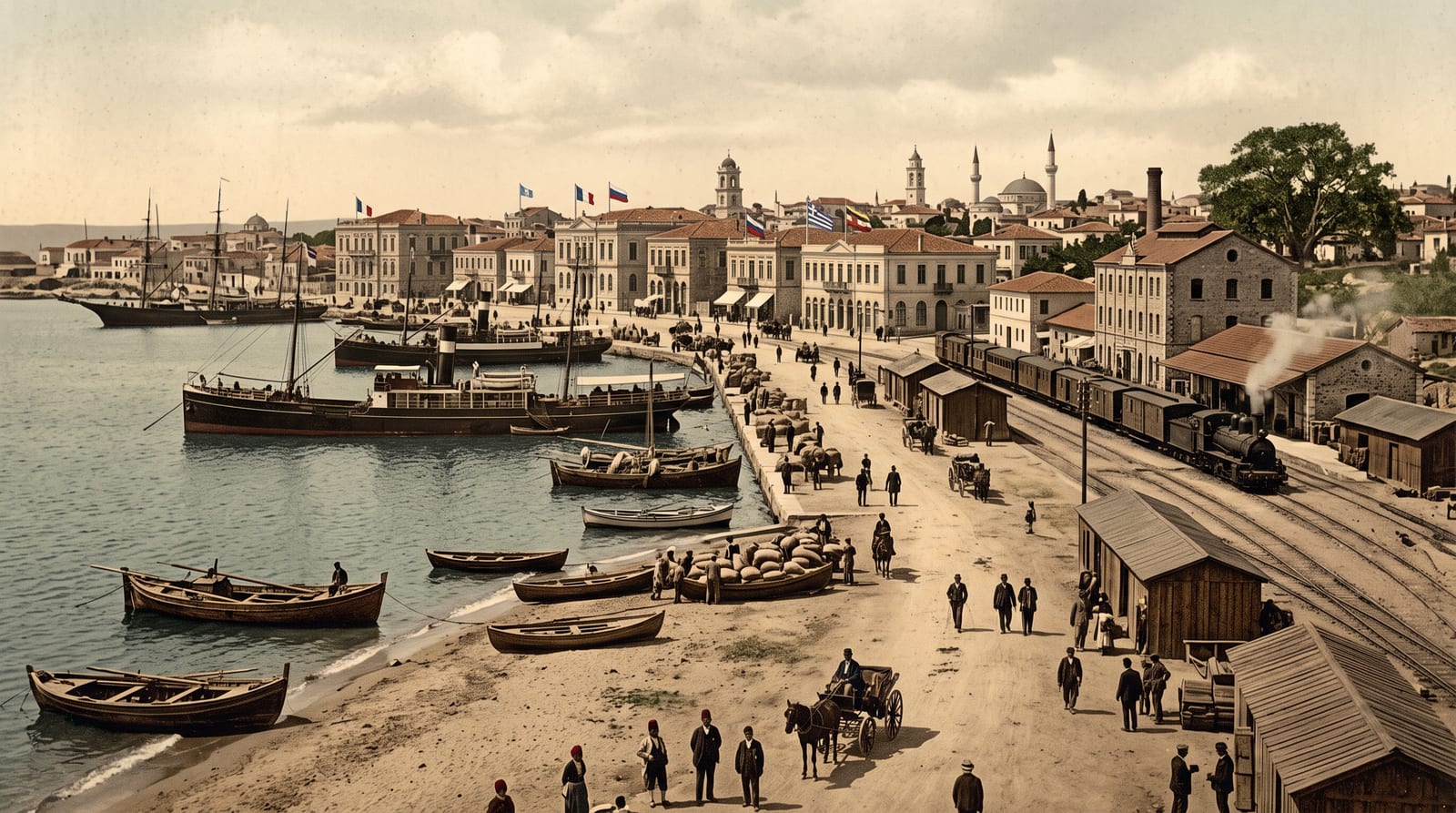
Dedeagats 1870-1920: from fishing village to a city of 8 consulates
Alexandroupoli is the youngest city in Thrace. It did not exist in 1821. It was born in 1870 because Ainos failed to become a port. In 40 years, it went from a deserted beach to the administrative capital of a Sanjak, with 8 consulates, 6 churches, and 2 mosques. Its name, Dedeagats, means "the old man's tree" in Turkish - dede, old man; agac, tree. 1870-1872: The railway gives birth to a city After the Crimean War (1854-1856), the Ottoman Empire decided to connect itself with Europe. In 1861 Abdulaziz became sultan, seeking an opening to the West. On 17 April 1869 a contract was signed with the German-Jewish entrepreneur Maurice de Hirsch. He founded the "Imperial Railways of European Turkey" company, based in Paris. The goal: a Constantinople-Vienna line via Adrianople, Sofia, Nis, Sarajevo, and Banja Luka. The network had 4 branches: Edirne-Dedeagac, Plovdiv-Burgas, Nis-Serbia, Pristina-Thessaloniki. The Adrianople (Karagats) - Dedeagats line began in May 1871 and was completed in June 1872. Initially, the plan was for it to terminate at Ainos. But the marshy, unstable ground and the mud that rendered the harbour useless - large vessels could not approach - made the project unviable. The economical solution was preferred: the line would run parallel to the western bank of the Evros and terminate at the deserted bay of Dedeagats. In 1872, as the 3rd Gymnasium of Alexandroupoli " Domna Visvizi " records, the first buildings began to go up: a railway station, warehouses, a customs house, and premises for the administration, the staff, and the workers. The steam-powered flour mill of Georgios Protopapas was built in 1874 next to the station. The first history of Dedeagats (1875) Our first history comes from the consul of Adrianople, K. Vatikiotis, in a memorandum to the Ministry of Foreign Affairs in early 1875: "Dedeagatsion, formerly a deserted shore, became known once those who surveyed and undertook the construction of the railways of European Turkey decided to build there the head of the Thracian and Bulgarian railways... ...the cereal crops of Thrace are now dispatched by railway... and the export of the other rich products is now conducted almost exclusively through Dedeagatsion... For this reason, people of every nationality are flocking to and settling in Dedeagatsion... and this formerly deserted shore is destined to be transformed into a city... The Greek subjects settled in Dedeagatsion number about fifty, engaged in various professions... They have now formed a brotherhood, to see not only to the construction and maintenance of an Orthodox church, but also to the support of the Greek schools of the neighbouring villages." The first settlers came from Ainos, Maroneia, Makri, Samothraki, and the wider Thrace. Alongside them were European employees of the Oriental Railways, officials of the Turkish administration, Armenians, and Jews. 1896: The second line - Dedeagats becomes a hub In 1893 a contract was signed with a consortium of banks and the "Chemin de fer jonction" (JSC) company was created, taking on the Thessaloniki-Dedeagats line. It was designed 15km inland from the sea so as to be out of range of enemy ships, following recommendations by Ottoman army officers, and with military stops. It was delivered at the end of March 1896. Initially it terminated at Feretzik (Feres), where it paid tolls to the Oriental Railways company. In 1909, after negotiations, the Potamos-Dedeagats lines were laid, with the company's own stations and access to the city and the port. It terminated above today's stadium - that was where the central station stood. The station was shelled in 1915 by Anglo-French ships during World War I and was destroyed. Afterwards, the station at today's KAPI building came into use. The "Gare Militaire" (military stop) is today a nursery on Rodou street. After the second line, Dedeagats became a commercial centre. By 1900 the population had more than doubled, reaching 8,000, with a predominance of the urban-commercial element. All the grain of Thrace left through the port. 1910: The city of 8 consulates In 1878 the Sanjak of Didymoteicho was formed out of territories from Gallipoli, Adrianople, and Samothraki (which until then belonged to the Vilayet of the Archipelago). Its seat was initially Didymoteicho, transferred to Dedeagats in 1884. The Sanjak had 3 kazas: Dedeagats (Feretzik, Mekri, Sahinler, Samothraki, Doganhisar), Soufli, and Ainos. In 1910, according to research by Ioannis Sidiras, the city was the administrative capital of the Sanjak, falling under the Vilayet of Adrianople, and the second ecclesiastical seat of the Holy Metropolis of Ainos (Metropolitan Ioakeim Georgiadis). It was connected by road and rail with Constantinople and Thessaloniki (12 hours), and by sea with Kavala (8 hours). Population in 1910: 2,310 Greeks, 1,542 Muslims, 369 Bulgarians, 325 Armenians, 230 Jews, 100 Catholics. Churches: 1 Greek with 3 priests, 1 Bulgarian, 1 Armenian, 1 synagogue, 1 Catholic, 2 mosques. Schools: a seven-grade Urban School for Boys with 430 pupils and 5 teachers, a six-grade girls' school with 133 pupils and 6 teachers, a kindergarten with 130 infants. The Turkish school had 200 pupils, the Bulgarian 46, the Armenian 50, the Jewish 30, the Catholic 25. Associations: the Philomouson Society, the Greek Club, the Musical Society, and the Ottoman Club of the Young Turk Committee (1908). Authorities: a Mutesarrif (governor), a military commander, a tax mudir, a gendarmerie chief, a police director, a harbourmaster, a customs officer, a mayor, an engineer, a doctor, a veterinarian, a sanitation director, and a mudir of post and telegraph. In operation: Austrian and French post offices, a military and a municipal hospital, and branches of the Ottoman Imperial Bank, the Bank of Thessaloniki, and the German Bank of the East. Consulates: England, Austria-Hungary, Germany, France, Greece, Italy, Persia, and Russia - 8 consulates. Professions (1910): flour merchants, soft-drink manufacturers, coachmen, coal merchants, life/marine/fire insurers, steam millers, booksellers, dairymen, grain merchants, lawyers, customs brokers, doctors, tobacco merchants, cafe owners, wine sellers, innkeepers, steamship agents, tailors, bankers, printers, pharmacists, goldsmiths, watchmakers. 1912-1920: Three occupations, one liberation 8 November 1912: the Bulgarians seize Dedeagats in the First Balkan War, pushing the Turks back as far as Chatalja. Treaty of London, 30 May 1913. 11 July 1913: the Greek army temporarily occupies Dedeagats in the Second Balkan War. Treaty of Bucharest 1913: Dedeagats is given to Bulgaria as its only outlet on the Aegean (110 km of coast). 1913-1919: Bulgarian administration. 14 May 1920: Liberation. The National Defence Army Corps under Major General Emmanouil Zymvrakakis receives an Allied mandate. The operation came by land (from Xanthi) and by sea - a landing at the port with the troopship Mykali, with units of the Division of Xanthi under Mazarakis-Ainian . Dedeagats was first renamed Neapoli (proposed by Achilleas Samothrakis ) and then Alexandroupoli, in honour of Alexander I . In 1929 the Oriental Railways were ceded to the French company "Compagnie Franco-hellenique," in 1954 they were bought out by the Greek state and incorporated into SEK, later OSE (1971). Visiting today The Army General Staff administration building today houses OSE offices. The port station, the Gare Militaire (the nursery on Rodou street), and the 1872 customs house all survive.
Ιστορία
1821 in Thrace: the band of Ortakioi and the Holocaust of Samothraki
Alexandroupoli did not exist in 1821 - it was still sea. But Thrace rose up. It could not revolt the way the Morea did - it lay next to Constantinople, with a strong Turkish army, and without mountains for guerrilla warfare. So the revolution took other forms: members of the Filiki Etaireia, men of the Sacred Band, and two events that marked our region - the band of men from Ortakioi and Mandritsa who left to join Ypsilantis, and the Holocaust of Samothraki on 1 September 1821. Preparation: Thrace before 1821 Thrace had already prepared itself intellectually. From the 15th century, the communities ran schools and libraries in Adrianople, Plovdiv, Ainos, Didymoteicho, Ganochoria, Silivri, and Sozopol. A pioneer of this awakening was the Adrianopolitan archimandrite Theoklitos Polyeidis, with his "Oracles of Agathangelos" (1750), which foretold liberation and had an enormous impact at the court of Catherine II in St Petersburg. The Filiki Etaireia was founded in 1814 in Odessa by Xanthos, Skoufas, and Tsakalof. The historian Ioannis Filimon records 700 members, of whom 31 were Thracians, and comments: "if the Greek merchants of the West and the North conceived the revolution of 1821, and the Greeks of Odessa gave birth to it, the Greeks of Thrace nursed it." The fourth member of the Filiki Etaireia, alongside the three founders, was the Plovdiv merchant Antonis Komizopoulos. His house survives today in Plovdiv as an ethnographic museum. A major role was also played by Grigorios Maraslis, of the "Red House" of Odessa, which housed the Foundation for Hellenic Culture. In Adrianople, the members met at the house of Amiras, near the metropolis. The most prominent were Sotiris Kokias, Dimitrios Chatzistanou, and Dimitrios Letzoglou. The band of Ortakioi and Mandritsa (1821) The most immediate event for the Evros region. In 1821 the bishop of Litiki, Sofronios, a member of the Filiki Etaireia - the bishopric of Litiki lay in Thrace, seated at Ortakioi in Northern Thrace - formed a revolutionary band from the men of Mandritsa and Ortakioi, that is, the Greek inhabitants of Ortakioi and Mandritsa. They crossed Turkish-occupied Bulgaria, joined the forces of Alexandros Ypsilantis, and took part in the revolution in Moldo-Wallachia. Fighting alongside them were: Thanasis Karabelias, or Belias , from Kornofolia in Evros - he had formed a guerrilla band at Soufli, was initiated into the Filiki Etaireia in 1818, and followed Ypsilantis. He was captured crossing the Rhodope and hanged in Adrianople (according to another oral tradition he survived and fought in southern Greece, and was immortalised in folk songs). Kara-Giannis, or Giannis Karafylidis , from Sidion (Sahinkioi of Malgara) - he was killed and buried in Odessa. According to oral tradition, together they led 1,500 men from Thrace to Moldo-Wallachia. Georgios Giannakoudis from Kornofolia - he fought in Moldo-Wallachia and southern Greece and returned unharmed. Thrace and the Sacred Band - Dragatsani Many young Thracians studying at the universities of central Europe and at the Princely Academies of Bucharest and Iasi joined the ranks of the Sacred Band and fell at Dragatsani. Those who survived were cared for in Odessa by members of the Filiki Etaireia, or fled south - like the Xenokratis brothers from Samakovo; Konstantinos founded schools in Vizye and Messolonghi (the Xenokrateio Girls' School) and turned his house in Bucharest into a hospital for Greeks. The Holocaust of Samothraki - 1 September 1821 The island of Samothraki rose up in August 1821, led by locally initiated members of the Filiki Etaireia with help from the men of Psara. On 1 September 1821 a Turkish fleet under Kapudan Pasha Nasuhzade Ali Pasha / Kara Ali landed. It killed the greater part of the male population, took the women and children as slaves, and burned the houses. The massacre became a symbol of Turkish brutality - it was depicted in the painting by François Auguste Vinson, held at the Louvre Museum. According to a report by the Elders of Samothraki to the Iviron Monastery (1809), the main town had 350 families. Of the 15,000 inhabitants, 25 families survived. 700 men were slaughtered, and 1,500 were sold as slaves in the markets of the East. It was the beginning of the Turks' inhuman actions in the Aegean - Chios followed in 1822, Kasos on 27 May 1824, and Psara in June 1824. On 6 April 1836 the Five New Martyrs of Samothraki and Makri were martyred - a link to Makri, near Alexandroupoli. What happened in Thrace afterwards The revolution was easily suppressed, because of the flat terrain and the proximity to Constantinople. The Metropolitan of Maroneia, Konstantios, who blessed the weapons at the Protaton of Karyes in May 1821 alongside Emmanouil Papas and set off with 5,900 fighters in Chalkidiki, most probably fell at the battle of Rentina. Emmanouil Papas breathed his last aboard the ship of the Ainos captain Chatzi-Antonis Visvizis. But Thrace carried on: many Thracians served in the regular army, and in the first irregular cavalry under Nikitas Stamatelopoulos (Thracian and Bulgarian grooms who had escaped from Tripolitsa) - and above all, the captain Domna Visvizi from Ainos. Memory today The Samothraki Holocaust Monument, and Vinson's painting at the Louvre The educational project "The destruction of Samothraki in 1821" - 3rd Gymnasium of Samothraki, 27/05/2024 The documentary "The Five New Martyrs of Samothraki & Makri" - with interviews of Metropolitan Anthimos of Alexandroupoli For Alexandroupoli, 1821 is not the history of a city but the history of a region - the land of the Kikones , which became the Samothracian Peraia, which became the Sanjak of Dedeagats , which became Alexandroupoli in 1920.
Ιστορία
Sali & the Kikones: the ancient city beneath Alexandroupoli
Alexandroupoli is the youngest city in Thrace - founded in the mid-19th century as a fishing village by fishermen from Ainos, Makri, and Maroneia. But beneath its asphalt lies an ancient city: Sali. Herodotus mentions it when describing Xerxes' campaign of 480 BC; it was part of the Samothracian Peraia and, before that, the land of the Kikones whom Odysseus fought. The Kikones - the first inhabitants According to Herodotus (7.59), the whole zone from the Evros Delta to Lake Vistonida and the foothills of the Rhodope "in olden times belonged to the Kikones." The Kikones are the Thracian tribe Odysseus encounters immediately after Troy. In the Odyssey (book 9), Odysseus and his 12 ships stop at Ismaros, the city of the Kikones. There he spares Maron (son of Evanthes), the priest of Apollo, who lived in a dense grove of Apollo. Maron gives him the Maronean wine with which he later intoxicates the Cyclops Polyphemus. Ismaros is identified with Mount Ismaros near Maroneia. The Kikones fought bravely alongside the Trojans. Homer mentions Maroneia as Maron's homeland. The Samothracian Peraia The history of the Thracian shore opposite Samothraki was shaped by the six settlements of the so-called Samothracian Peraia: Zoni, Drys, Mesimvria, Sali, Tempyra, and Charakoma. Herodotus (7.108) calls them "Samothracian walls," that is, fortified positions. They were the mainland possessions and fortresses of Samothraki - the Samothracian walls. They controlled the passage into the Thracian hinterland, and had abundant timber, water, and an outlet to the sea. Most did not have large harbours like Maroneia or Stryme, but they were strategic. Sali The ancient city of Sali was probably founded by the Maroneans. The earliest reference is in Hecataeus of Miletus (6th c. BC), who describes it as a "city of Thrace," and Zoni as a "city of the Kikones." Herodotus describes Xerxes' campaign: "the shore adjoining Doriskos, where the Samothracian city of Sali is built, and Zoni, and last of these the famous cape Serreion. This region in olden times belonged to the Kikones" (7.59). Shortly afterwards: "as he marched from Doriskos he passed first the Samothracian walls, of which the westernmost is the city named Mesambrie" (7.108). So Mesimvria lies furthest west, with Sali and Zoni further east, near Doriskos. Scylax (4th c. BC) records: "Opposite these is the island and harbour of Samothrace. Opposite this, on the mainland, are the trading posts of Drys, Zoni..." In the years of the Peloponnesian War, Drys and Zoni (and Sali) were detached from Samothraki and joined the Athenian League - the tribute list IG I3 77 (422/421 BC) records them as "by Serreion." Serreion is cape Ismaros, the passage to the hinterland mentioned by Demosthenes. Where is Sali today? Early scholarship (Bakalakis 1961, Muller 1975, Isaac 1986) placed Sali at Alexandroupoli. Chance finds have indeed been made in Alexandroupoli: black-glaze pottery, two Hellenistic cist graves, a boundary inscription of the 1st c. AD, a headless marble statue of a youth, part of a pilaster with a cyma and a relief head, and above all a slab inscribed "Boundary of the sacred land of the Gods of Samothrace," which confirms the identification of the site. According to the Roman Itineraries (the Itinerarium Antonini and the Burdigalense), in Roman times there was a station of the Via Egnatia at Sali, the next one after Tempyra for travellers coming from the west. Subsequently, Mottas (1989) identified it with Makri, following the Jerusalem Itinerary, which places Sali 15 miles from Traianoupolis - a view considered more persuasive today (Loukopoulou et al. 2005, Psoma 2008, Tsatsopoulou-Kaloudi 2015). So Sali lies either beneath Alexandroupoli or just to its west, above the settlement of Makri. This is why the first boutique hotel in Thrace was named "Sali" - the name has its roots in Herodotus and in the Via Egnatia. What you can see today There is no organised archaeological site of Sali in Alexandroupoli. There are: Chance finds at the Archaeological Museum of Alexandroupoli Zoni has been precisely identified - it is being excavated at the point where the Paliorema torrent (Sapli Dere) flows out, west of Mesimvria The ArcGeoPerSa programme (Democritus University of Thrace + FORTH + the Ephorates of Rodopi/Evros + the Hellenic Foundation for Research) is conducting systematic surface survey, geophysical prospection, and remote sensing across the whole Peraia Why it matters Alexandroupoli has no ancient wall to show, but it has something rarer: it is built on top of one of the six fortress-cities of Samothraki that controlled the entire passage from the Aegean into the Thracian hinterland, from the 7th c. BC until Roman times. From the Kikones of Odysseus, to the Samothracians, to Xerxes in 480 BC, to the Athenian League in 422 BC, to the Via Egnatia station, to the fishermen of 1850, to the Dedeagats of 8 consulates, to the liberation of 1920.
 FEATURED

%20scale(8.3333)%22%20fill%3D%22none%22%20stroke%3D%22%237c5fb0%22%20stroke-width%3D%221.4%22%20stroke-linecap%3D%22round%22%20stroke-linejoin%3D%22round%22%3E%3Cpath%20d%3D%22M3%2010l9-6%209%206%22%20%2F%3E%3Cpath%20d%3D%22M4%2021h16M5%2021V10M9%2021V10M15%2021V10M19%2021V10%22%20%2F%3E%3C%2Fg%3E%3C%2Fsvg%3E)